Priene: a commanding view into ancient times
Perched on a cliff, with the Meander Delta below and Mount Mycale (Samsum) above it, this remarkable ancient city is a must-see for history lovers.

Wrapped around a beautiful Aegean gulf with gorgeous sunsets nearly every evening, Izmir is an amazing city to visit. But many of the “touristy” things that people want to do on their visits to Turkey — sun-kissed beaches, ancient cities, natural wonders — lie about an hour’s drive from the city.
Further afield, with drives of two to three hours (add 50% for public transport) lie many more fascinating places, and I want to start a series on these sites, grouping them by one of my favorite American pastimes: the Road Trip. As I describe these places, I’ll couple them with a tale I have written each month.
Our first destination is Priene.
One of my favorite genres is adventure, and one of my favorite moments in an adventure tale is when the heroes pass through a portal and enter a forgotten world: it could be Jonathan Swift’s Lilliput or the continent at Jules Verne’s Center of the Earth or the Island of Monte Cristo in Alexandre Dumas.
Remote and lightly visited, Priene feels like a “lost city” in an adventure tale. My “adventure senses” always activate when I’m there, despite the fact that I have visited seven times now.
Priene is a place where history, natural beauty, and amazing, death-defying adventures await the traveler.
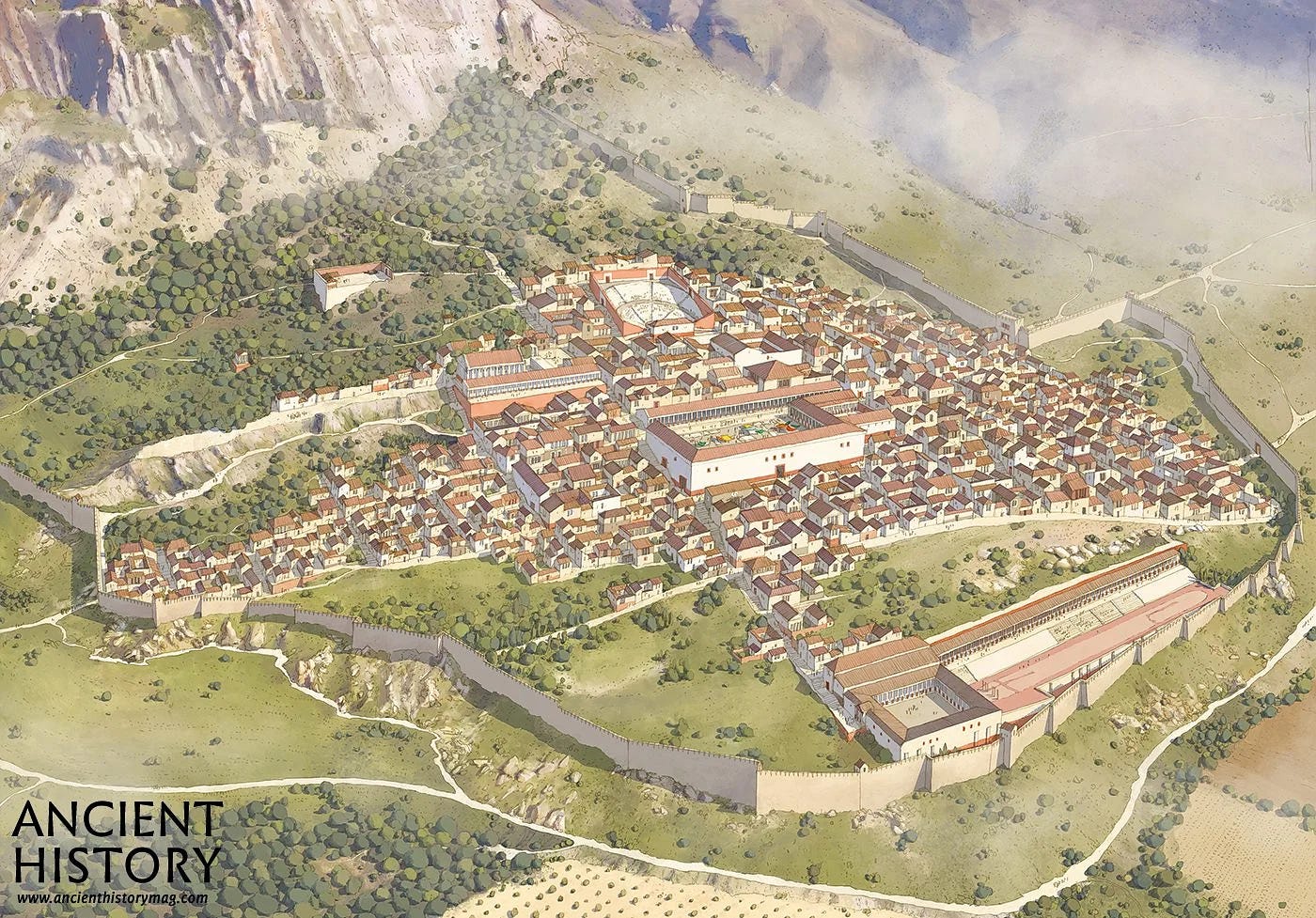
What Priene Was
To understand the history of Priene, visitors must understand a natural feature that disappeared a millennium ago: the Gulf of Latmos, a broad arm of the Aegean Sea that once reached far inland and made Priene a port city.
Today the delta of the Meander River has filled in the bay (with the exception of Lake Bafa, which still waters the base of Mount Latmos [Beşparmak Dağ], a rocky mount that lies about 20 miles south of Priene). Instead of ships racing about, connecting Priene to the nearby cities of Miletus and Myus — as well as colonies from the African coast to the Black Sea — one finds cotton plantations and pomegranate orchards today.
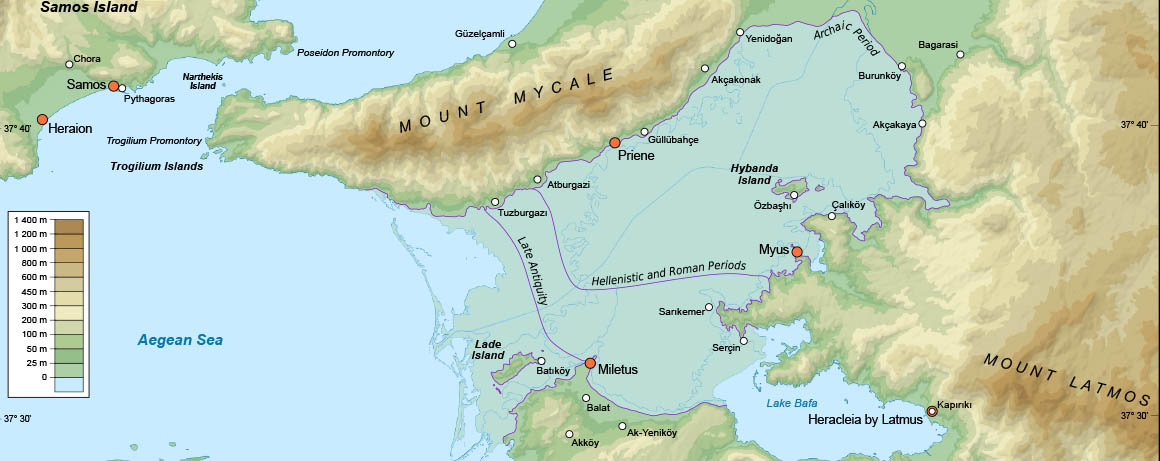
In history, the city followed the shrinking coastline of the Gulf of Latmos, moving three times between its founding as a pre-Greek, Carian city called Kadme and its current location, which was built in 400 BCE during the time of the Persian satrap of Halicarnassus, a ruler named Mausoleus.
Scholars trace the founding of Greek Priene to the nearby mother city (Greek: metropolis) of Miletus, which was conquered by Myceneans in the 11th Century BCE. Tradition holds that Aepytus, son of the Greek conqueror of Miletus, conquered the city. Some traditions tie the city’s founding to the tribe of Amazons, female warriors who also have connections to the founding of both Ephesus and Smyrna/ Izmir.
In the 4th Century BCE the current city was founded on the slope of Mount Mycale, a steep climb from its harbor on the still-extant gulf. It was one of the first cities in the world designed in a grid, an idea that had been invented in nearby Miletus by Hippodamas (498-408 BCE). Even today the streets of the city are straight and intersect at right angles — it is easy to overlook that these are some of the first straight streets and street corners in civilization.
The most famous citizen of Priene was a poet-lawyer named Bias (600-550 BCE), who was renowned in his day as one of the Seven Sages of the Greek world. Besides his work as an advocate, he wrote a 2,000-line poem, On Ionia, which was famous in its day but is now lost.
Priene lay at the heart of the Ionian League of twelve Greek city-states that rose between 700 and 500 BCE. On the other side of Mount Mycale1 lay the Panionion, a ground for meetings, religious festivals, cultural performances and athletic games among the cities in the league. And Priene, the closest city to the site, served as host for the festival and presided over ceremonies.
(I have hiked from the Panionion over the crest of Mount Mycale to Priene. It’s 15 km as the crow flies, but it is a challenging hike through arid scrub, slippery slopes of loose rock, and sharp boulders.)
In 499 BCE, spurred on by Athens, the Ionian League revolted against Persia, which had dominated the area since 545. For six years the League maintained independence, but their navy was crushed at the Battle of Lade just a few miles from Priene. Darius the Great resumed control, exacting a steep price on the rebellious cities, deporting the residents of Miletus and Didyma and vowing to make an example of Athens.
Seventy-five years later, Alexander the Great lodged in Priene as his forces besieged Miletus — now a Persian stronghold. The “Alexander House” is part of a walking tour of the city, and he also funded the renovation of the Temple of Athena there, one of the city’s most beautiful sites.
Priene endured into the Christian Era. It was the seat of a diocese in Byzantine Times, but the Meander Delta was encroaching and trade dried up. It was conquered by Turks at the end of the 13th Century CE. The Turkish town of Güllübahçe (“rose garden”) lies below the ancient site today.
What to see: a Walk through the Ancient City
As I mentioned above, Priene is laid out on a grid with three main streets running parallel to the face of the cliff that towers about the city. The road from the parking lot passes through the East Gate onto “High Street.” Turn right on the first cross street, Theater Way. On the corner closest to the gate is the Upper Gymnasium, a ground for training young men in the arts of war: physical strength, rhetoric, and music.
Beyond the gymnasiuim on Theater Way is a large courtyard covered by trees. This is the Court of Egyptian Gods, one of five temples in the city. The temple was staffed by Egyptians and served a community brought to Priene and Miletus by the Mediterranean Sea-spanning trade networks that connected Ionia and Egypt.
Turn left at the end of the street, and you enter the theater. Though only the first few rows have been restored, it once held up to 5,000 spectators. Four ornate marble benches sit directly off the orchestra, and an altar remains for the traditional sacrifice to Dionysus that preceded each performance. (In spring the area around the altar grows greener than the rest of the chorus area, still fertilized by the blood of sacrifices.) The path from Theater Way passes directly beneath the stage.
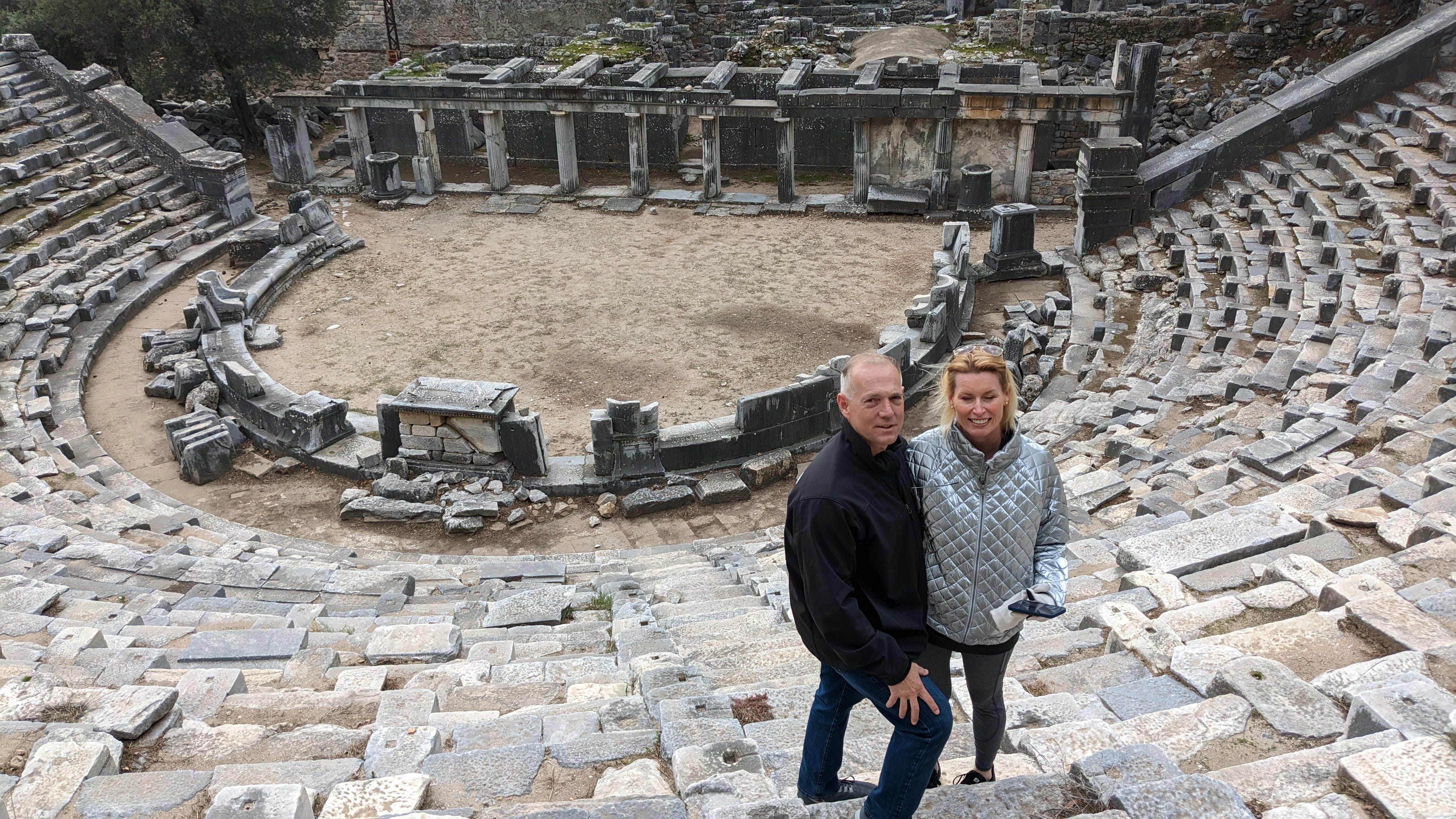
Exit the theater stage left, and you’re soon in a shaded Christian church with a baptisty and small podium remaining in the middle of the floor. Continue to the right and you return to High Street in time to reach Priene’s most remarkable building: the Temple of Athena, with its five Ionic columns standing tall, framed by the high gray cliff of the city.
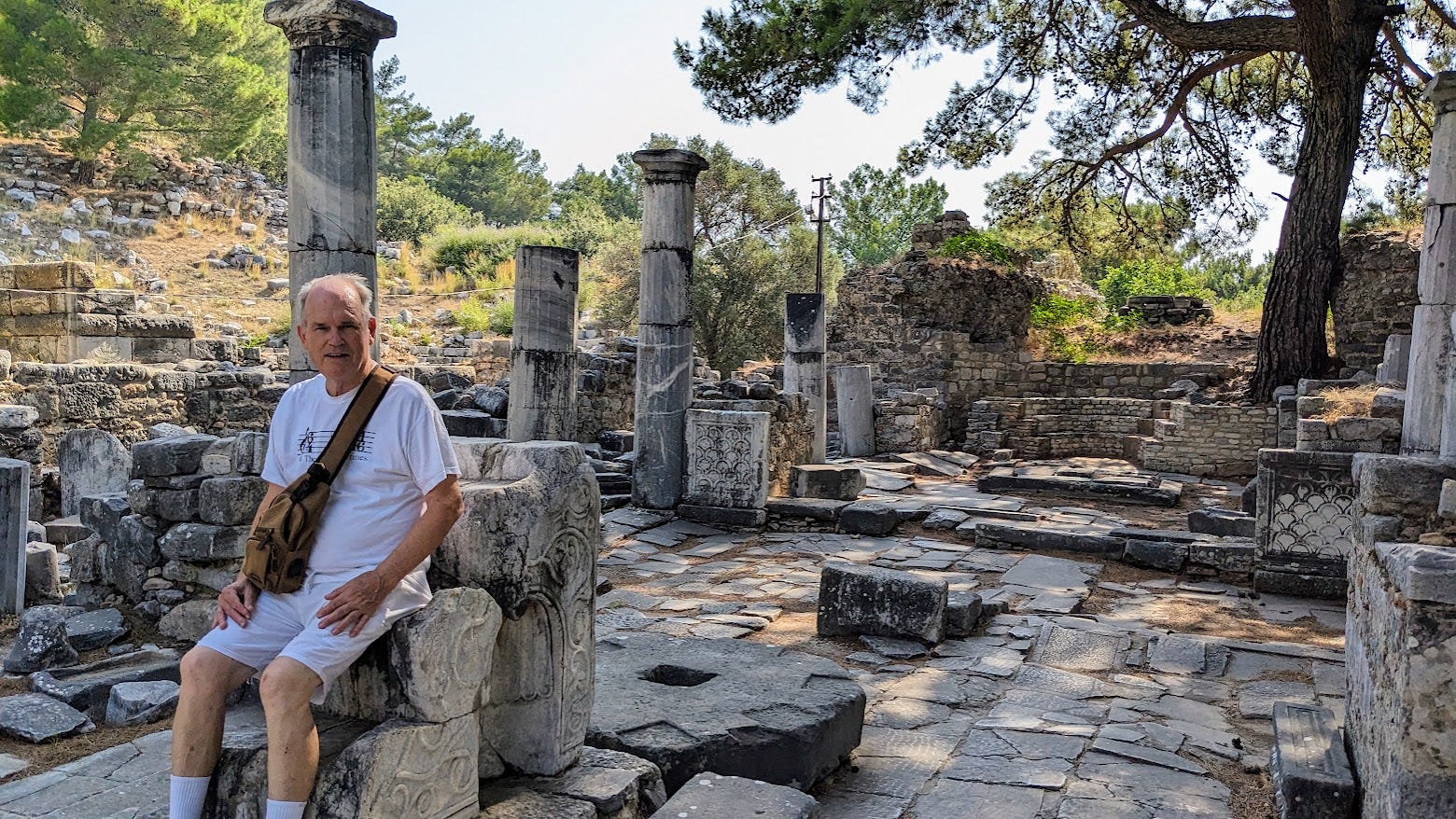
The Temple of Athena was funded by Alexander during his stay in Priene in 334 BCE. It’s architect, Pyteos, would go on to greater fame in Halicarnassus (known today as Bodrum) where he contributed to the Mausoleum, one of the Seven Wonders of the Ancient World. In front of the temple lies a large plaza which offers commanding views of the Meander Valley. I love standing here, imagining the huge bay that once separated Priene from the far hills, full of ships whose cargoes spanned the world from the Black Sea to Egypt and Italy.
High Street disappears into woods and rubble after the temple. A staircase does down to Main Street (the middle of the three east-west boulevards), turning toward the eastern gate takes one into the heart of Priene. On the left (the mountain side of the street) lay the 116-meter-long Sacred Stoa. Priene residents climbed six steps from the street to enter two long halls, separated by columns, where lay statues of gods and heroes: a shady, communal space at the heart of the city. On the back wall of the Stoa, inscriptions told the story of Priene and its greatest citizens.
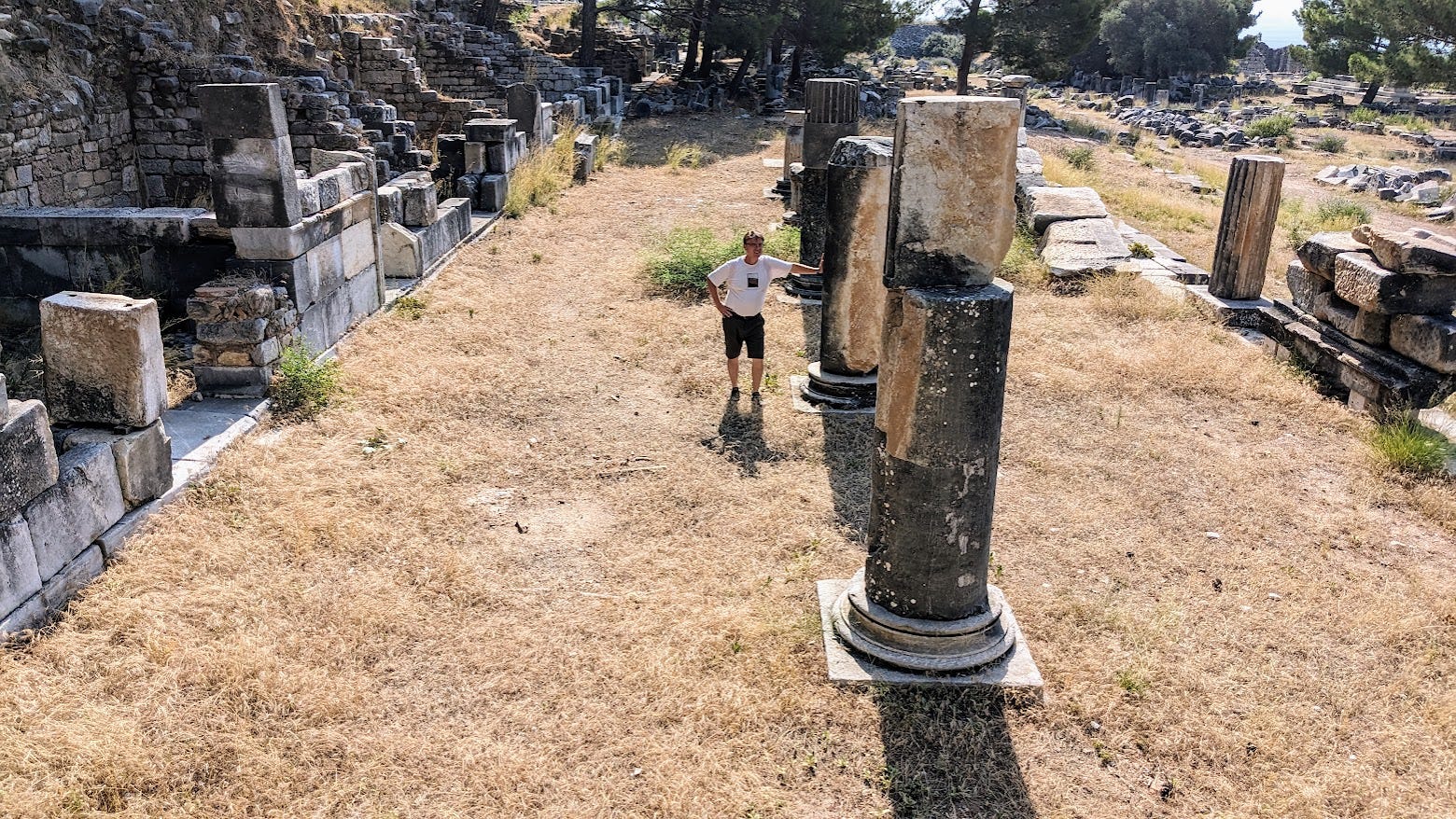
On the other side of Main Street lay the agora, open to the street with colonnades on the other three sides. West of it, closer to the residential area, lay a separate food market.
The bouleterion or council chamber lies just a few meters off Main Street just past the stoa. It is a series of steps arranged in a square — rather than the semicircle of the theater — and it once sat up to 642 senators. On the corner of the Main Street and Theater Way — just past the bouleterion — was a small temple called a Prytaneion where the sacred fire of the city burned day and night. The civic quarter was completed on the other side of the street by a temple of Zeus Olympos.
At the Theater Way crossing, a turn downhill leads to the final of the three, primary cross streets, which I call Low Street.
On the corner of Low Street and Theater Way lies the Temple of Aesclepius — the health center of Priene, a city without a hospital. In ancient times, the sick were admitted to rooms where their dreams were more likely to be analyzed than their blood. This was a place of magic and inspiration — a place where snakes symbolized the god and had the run of the place.
Low Street ends in the agora. This is a good chance to cross the agora to Main Street and explore the residential areas of Priene — shaded today with pine trees. Cutting through the middle of the street is a trench that carried sewage down the hill and out of town. A synagogue was found among the houses, identified by its menorahs.
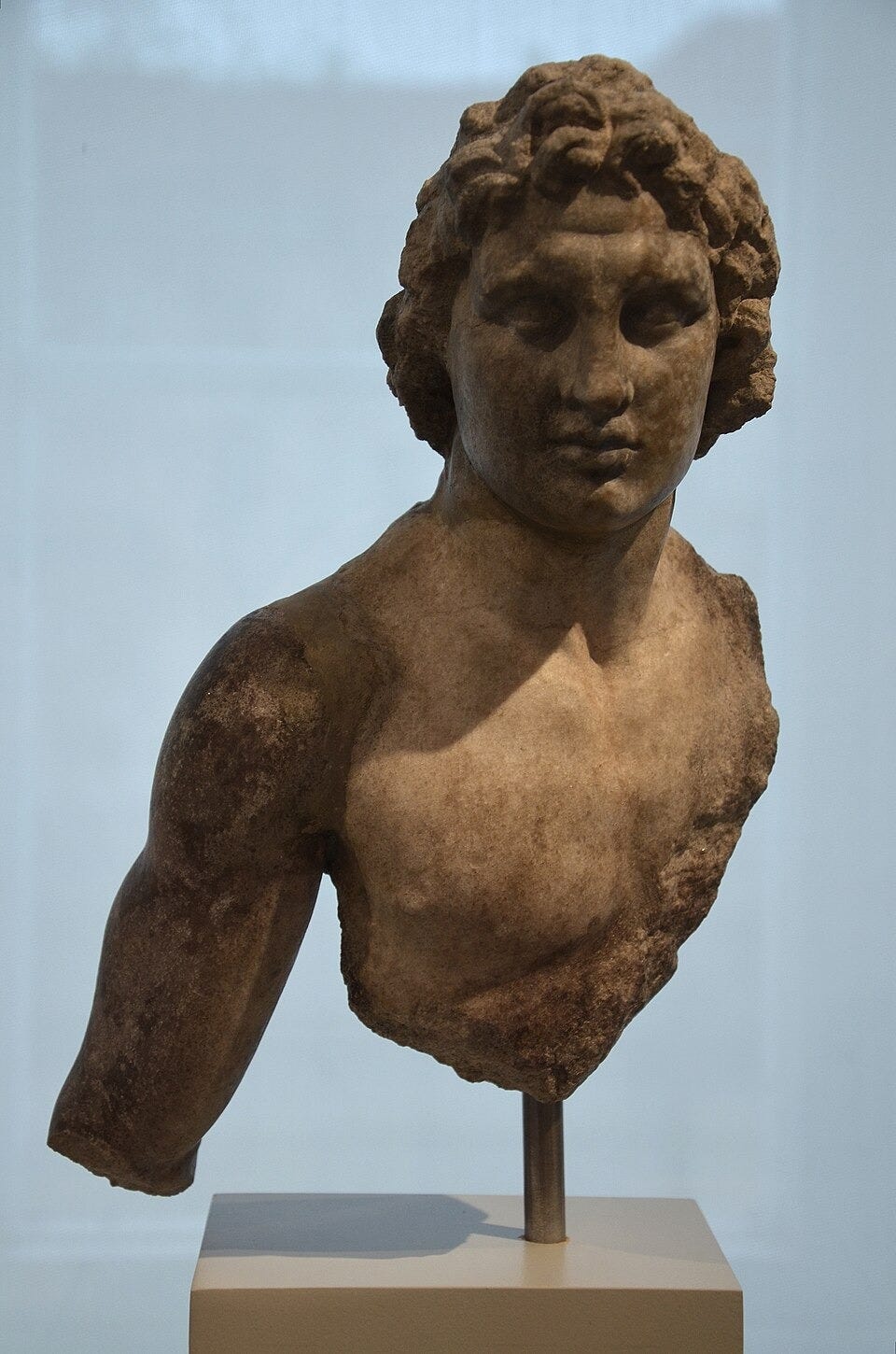
The key house in the residential section is Alexander the Great House, located just off main street. Tradition holds that Alexander stayed in Priene in 334 BCE, during the siege of Miletus. As archaeologists excavated this large home, they found a statue of Alexander. They believed that this house was a site of worship for the conqueror, if not his temporary residence in the city.2
,_200-150_BC,_Altes_Museum,_Berlin_(13740030734).jpg)
A second day: side trips around Priene
The tour described above is a two or three-hour tour that I take when I bring friends. Those with more time — or a greater interest — may enjoy the following sites around Priene.
Climb to the acropolis. The walls of an acropolis lie atop the gray cliff behind the city. A steep trail climbs diagonally across the face of the cliff to the very top. It begins behind the theater, a climb of 300 meters. Warning: this is a steep climb with a steep drop-off. Signs on the site warn hikers of the risk. I haven’t taken this hike yet… but I hope to.
Go down the steps to the gymnasium & stadium. A steep climb down to the valley from Low Street takes one to the sports complex of the city, a lower gymnasium for training and a stadium.
Temple of Demeter. A ways from the Temple of Athena lies another temple to the goddess Demeter and her daughter, Persephone. The temple isn’t on any of the streets, and it requires some hunting through the woods between the residential area and the cliff.
I have gotten lost a couple times on the site, and I have found myself among high, cyclopean walls that surrounded the city. There is plenty left to explore — yes, enough for seven more trips.
Beyond Priene
I like to combine Priene with the cities of Miletus and Didyma on a day trip from Izmir.
Miletus, about 10 miles from Priene, was the largest city on the Aegean in ancient times — it would be eclipsed by Ephesus in the Roman Era. The city features a gigantic Roman theater, complete with a Byzantine castle on the hill above it. Beyond the theater are many buildings including Roman baths, a city council, and the central harbor of the city.
Didim, a further 10 miles from Miletus, features the Apollon, a monumental temple of Apollo with three, incredible 20-meter-high ionic columns and a fascinating inner chamber where priests interpreted the future for believers.
Myus is a small site with a few walls remaining, rising on a low hill above the Meander Delta.
How to Get to Priene
Priene lies above the town of Güllübahçe. From Izmir or Kuşadası, take a coach to the city of Söke. The coaches arrive at the bottom floor of the bus terminal. Local busses called dolmus, leave from the top floor of the terminal, and travelers can find regular service to Güllübahçe. Priene is a 2 km hike from the town.
I usually rent a car for the trip, as I like to visit Miletus and Didyma on a day trip. Car rentals can be found at the Izmir airport as well as in offices in Kuşadası and Didim.
The Meander Delta is flat, and it makes a nice excursion by bicycle, although riders will face a climb to Priene and over a series of hills to Didyma. The side roads east of Söke are lightly traveled and safe for riders.
Another one of the Seven Sages, Thales of Miletus, was connected to Mount Mycale, which he used as an observatory. He was one of the first humans to correctly predict an eclipse.
Key insights about Priene came from Izabela Miszczak’s book, Around Ephesus and Kusadasi: TAN Travel Guide (2016)
.